National Startup Day 2026: A Decade of Building for India
Marico and Marico Innovation Foundation (MIF) reflect on ten years of Startup India and the diversity shaping India’s next phase of innovations.
By Marico Innovation Foundation January 16, 2026 | 11:00 AM
Startups are shaping the Indian entrepreneurship landscape and rewriting the story of how India thinks about innovation, responsibility, and scale. Celebrated every year on January 16, National Startup Day recognises the founders and teams that have helped India establish itself as the world’s third largest startup ecosystem. 2026 marks a full decade of Startup India. Over ten years, this journey has helped shift India’s narrative from one of job seekers into a powerhouse of job creators. At the Marico Innovation Foundation (MIF) and our parent company Marico Limited, we celebrate this milestone by looking back at what has enabled this momentum, and what will sustain it ahead.
India’s Startup Story: Scale Meets Spread
With nearly 2 lakh startups creating lakhs of jobs, the scale of India’s ecosystem is undeniable. So is the signal it sends: entrepreneurship is one of the mainstream pathways of economic participation and problem solving.
Subscribe to InnoWin
Get insights, lessons, and candid stories from entrepreneurs, investors, and change-makers driving India's innovation ecosystem—once a month.
India’s rise to the 38th rank in the Global Innovation Index (GII) 2025 is another marker of this deepening capability. What stands out, is not just the scale but also the spread of entrepreneurship across geographies, sectors, and problem statements.
The Non-Metro Surge
While Bengaluru, Delhi, and Mumbai continue to anchor the ecosystem, a visible non-metro wave is reshaping the Indian startup map. State-led ecosystem building has become a meaningful differentiator.
Telangana, Kerala, and Odisha are emerging as centres of startup growth, supported by policy intent, decentralised incubation models, and strong academic–industry linkages.
Telangana’s ecosystem has been shaped by platforms that convene startups, corporates, investors, academia, and government.
Kerala’s government-backed mission model has built a large incubation footprint and thousands of registered startups.
Odisha has put in place a startup mission with incubation and policy support.
Another important marker of spread is participation—women’s leadership in particular. As of October 2024, more than 73,000 of the govt recognised startups had at least one woman director.
Signals from Marico and MIF’s Innovation Pipeline
This diversification is reflected in MIF’s own journey. An analysis of startups recognised through ten editions of the Indian Innovation Icons Awards highlights how Indian innovation has expanded from traditional sectors into emerging domains.
From deep-tech and infrastructure, represented by companies such as Astrome Technologies in connectivity and Skyroot Aerospace in space, to sustainability-led solutions like Indra Water in wastewater treatment and Chara Technologies in clean mobility, the winners reflect innovation embedded in core economic systems.
Equally significant is the rise of inclusive, high-impact, problem solving organisations like Rocket Learning, which leverage technology to improve early childhood education outcomes and AssisTech Foundation, which enables assistive technology for persons with disabilities.
The breadth marks maturity, signalling an ecosystem aligned with India’s evolving economic, social, and environmental priorities.
AI, Sustainability and the Future of FMCG Innovation
The intersection of the FMCG sector and startup innovation is where Marico and MIF see some of the most exciting transformations. Traditionally defined by scale and efficiency, FMCG innovation is being reshaped by AI-enabled decision making, sustainable materials, and circular supply chains.
AI is being embedded across the FMCG value chain, from demand forecasting and inventory optimisation to traceable packaging and waste recovery. It is also changing how experimentation happens—helping teams test, learn, and iterate without losing sight of unit economics.
Indian startups are leading this shift:
Bambrew is replacing conventional plastics with compostable, plant-based packaging solutions tailored for FMCG and e-commerce.
Banyan Nation is advancing circular packaging through high-quality recycled resins and traceability-led systems.
ReCircle is enabling brands to digitally track and certify waste recovery across cities.
Nirmalaya and Eco Femme are showing how culturally rooted and consumer-centric innovations can deliver sustainability at scale.
These innovations are unfolding as the global sustainable packaging market, valued at over USD 270 billion in 2024, is projected to surpass USD 490 billion by 2034, driven by bio-based and compostable materials
Scaling Together: Where Startups and Large Enterprises Meet
One meaningful shift in recent years has been the changing relationship between startups and large organisations. Innovation is less about parallel tracks and more about shared journeys—where experimentation meets execution, and ideas gain strength through scale.
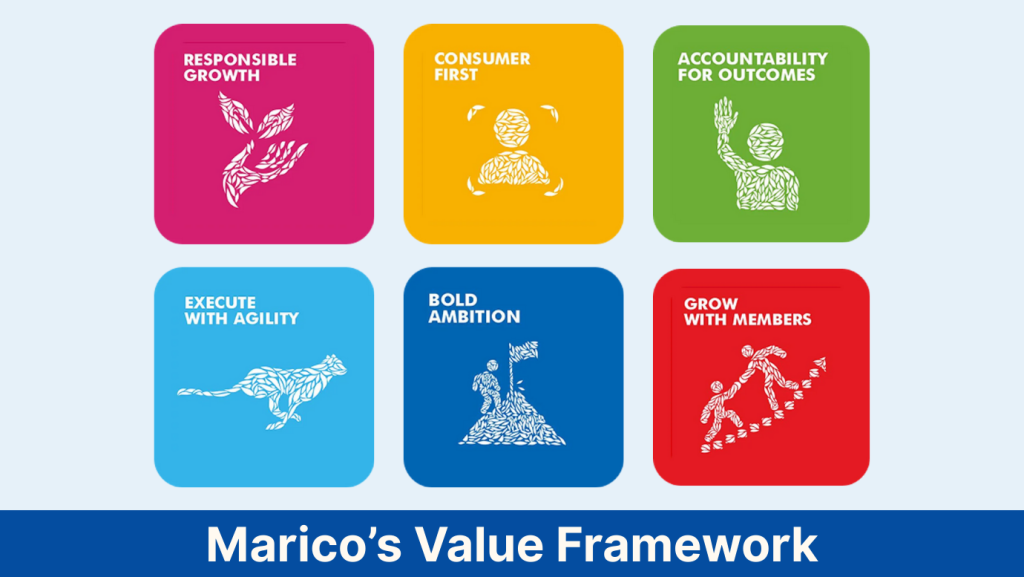
Marico’s Value Framework
Marico’s value framework—Consumer First, Bold Ambition, Responsible Growth, Grow with Members, Accountability for Outcomes, and Execute with Agility—map closely to principles that startups must build early if they want to scale without losing clarity.
This approach also informs initiatives such as the MIF Scale-Up program, which integrates startups into conversations around scale, governance, and execution.
Looking Ahead
National Startup Day is a celebration of entrepreneurship. It is also a reminder that innovation is a collective responsibility. When startups and enterprises collaborate, innovation becomes more than novelty; it becomes capability.
At Marico Limited and MIF, the focus is on enabling innovation—where bold ideas are matched with responsible growth, and where scale amplifies impact. A world without startups would be a one without new questions, fresh perspectives to achieve urgent challenges or the courage to rethink what already exists. India’s startup journey shows us that the future is not built by one kind of organisation alone—but by ecosystems that grow, learn, and evolve together.
Subscribe to InnoWin, MIF’s monthly newsletter, and get insights from entrepreneurs, investors, and change-makers on innovation, success and what it takes to get there.
With over 1,000 applications coming in for the Indian Innovation Icons 2027, a look at the sectors and social challenges driving India's next wave of game-changing innovations.